Usage
Quick start guide to use hierarchical linear regression using HLR package.
Fetch example data
Let’s first fetch some data and initiate the HLR object. We’ll use the penguins dataset from seaborn for our example.
import seaborn as sns
import pandas as pd

# Load the example penguins dataset
df = sns.load_dataset('penguins')
df.dropna(inplace=True)
df = df[['bill_length_mm', 'bill_depth_mm', 'flipper_length_mm', 'body_mass_g']]
Initialize HLR & generate summary report
from HLR import HierarchicalLinearRegression

# Define the independent variables for each model level
ivs_dict = {
     1: ['bill_length_mm'],
     2: ['bill_length_mm', 'bill_depth_mm'],
     3: ['bill_length_mm', 'bill_depth_mm', 'flipper_length_mm']
}

# Define the dependent variable
dv = 'body_mass_g'

# Initialize the HierarchicalLinearRegression class
hlr = HierarchicalLinearRegression(df, ivs_dict, dv)
hlr.summary()
Output:
| Model Level | Predictors | N (observations) | DF (residuals) | DF (model) | R-squared | F-value | P-value (F) | SSR | SSTO | MSE (model) | MSE (residuals) | MSE (total) | Beta coefs | P-values (beta coefs) | Std Beta coefs | Partial correlations | Semi-partial correlations | Unique variance % | R-squared change | F-value change | P-value (F-value change) |
|---|---|---|---|---|---|---|---|---|---|---|---|---|---|---|---|---|---|---|---|---|---|
| 1 | [bill_length_mm] | 333.0 | 331.0 | 1.0 | 0.35 | 176.24 | 0.0 | 140467132.89 | 215259665.92 | 74792533.03 | 424372.00 | 648372.49 | {'const': 388.85, 'bill_length_mm': 86.79} | {'const': 0.18, 'bill_length_mm': 0.0} | {'bill_length_mm': 0.59} | {'bill_length_mm': 0.59} | {'bill_length_mm': 0.59} | {'bill_length_mm': 34.75} | NaN | NaN | NaN |
| 2 | [bill_length_mm, bill_depth_mm] | 333.0 | 330.0 | 2.0 | 0.47 | 144.84 | 0.0 | 114633408.59 | 215259665.92 | 50313128.67 | 347373.97 | 648372.49 | {'const': 3413.45, 'bill_length_mm': 74.81, 'bill_depth_mm': -145.51} | {'const': 0.0, 'bill_length_mm': 0.0, 'bill_depth_mm': 0.0} | {'bill_length_mm': 0.51, 'bill_depth_mm': -0.36} | {'bill_length_mm': 0.56, 'bill_depth_mm': -0.43} | {'bill_length_mm': 0.49, 'bill_depth_mm': -0.35} | {'bill_length_mm': 24.47, 'bill_depth_mm': 12.0} | 0.12 | 74.37 | 0.0 |
| 3 | [bill_length_mm, bill_depth_mm, flipper_length_mm] | 333.0 | 329.0 | 3.0 | 0.76 | 354.90 | 0.0 | 50814911.80 | 215259665.92 | 54814918.04 | 154452.62 | 648372.49 | {'const': -6445.48, 'bill_length_mm': 3.29, 'bill_depth_mm': 17.84, 'flipper_length_mm': 50.76} | {'const': 0.0, 'bill_length_mm': 0.54, 'bill_depth_mm': 0.2, 'flipper_length_mm': 0.0} | {'bill_length_mm': 0.02, 'bill_depth_mm': 0.04, 'flipper_length_mm': 0.88} | {'bill_length_mm': 0.03, 'bill_depth_mm': 0.07, 'flipper_length_mm': 0.75} | {'bill_length_mm': 0.02, 'bill_depth_mm': 0.03, 'flipper_length_mm': 0.54} | {'bill_length_mm': 0.03, 'bill_depth_mm': 0.12, 'flipper_length_mm': 29.65} | 0.30 | 413.19 | 0.0 |
Run diagnostics for testing assumptions
diagnostics_dict = hlr.diagnostics(verbose=True)
Output:
Model Level 1 Diagnostics:
Independence of residuals (Durbin-Watson test):
DW stat: 0.8450671190941991
Passed: False
Linearity (Pearson r):
bill_length_mm: {'Pearson r': 0.5894511101769488, 'p-value': 1.5386135144860176e-32, 'Passed': True}
Linearity (Rainbow test):
Rainbow Stat: 0.845825915500362
p-value: 0.8589217163587981
Passed: True
Homoscedasticity (Breusch-Pagan test):
Lagrange Stat: 76.51043993569607
p-value: 2.1905189444330245e-18
Passed: False
Homoscedasticity (Goldfeld-Quandt test):
F-Stat: 3.298385120028286
p-value: 5.1841847326260096e-14
Passed: False
Multicollinearity (pairwise correlations):
Correlations: {}
Passed: True
Multicollinearity (Variance Inflation Factors):
VIFs: {}
Passed: True
Outliers (extreme standardized residuals):
Indices: []
Passed: True
Outliers (high Cooks distance):
Indices: []
Passed: True
Normality (mean of residuals):
Mean: -2.403469482162693e-13
Passed: True
Normality (Shapiro-Wilk test):
SW Stat: 0.9912192354166119
p-value: 0.04492289320888261
Passed: False

Model Level 2 Diagnostics:
...
Plotting options for all model levels
fig = hlr.plot_studentized_residuals_vs_fitted()
Output:
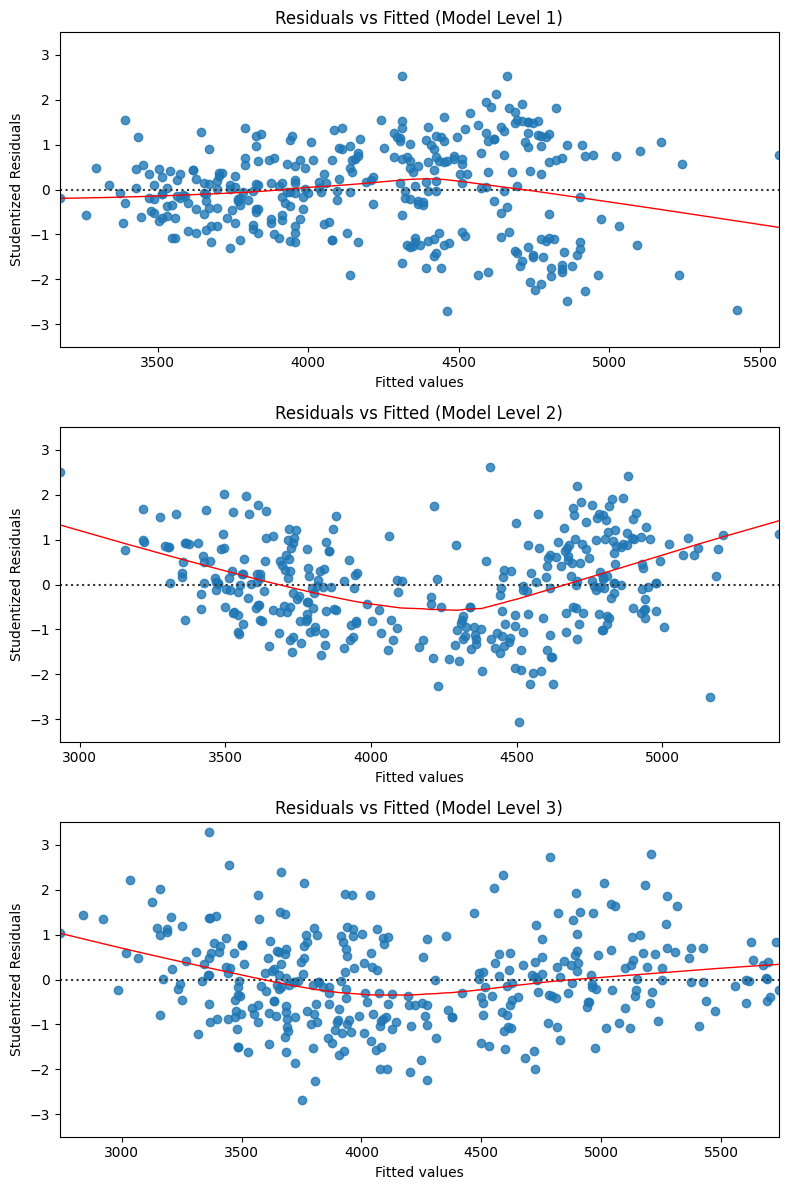
fig = hlr.plot_qq_residuals()
Output:

fig = hlr.plot_influence()
Output:

fig = hlr.plot_std_residuals()
Output:

fig = hlr.plot_histogram_std_residuals()
Output:

fig_list = hlr.plot_partial_regression()
Output:

(the fig_list contains a fig for each Model Level; only Model Level 1 displayed (i.e., fig_list[0]))